Marghera / Venice
Fincantieri’s Marghera yard is on Venice’s mainland industrial waterfront. Norwegian Prima was delivered here in 2022.
Fincantieri: vessel source ↗Place page →Behind every record-breaking vessel is a place capable of building it.
UNCTAD reports that China, South Korea and Japan accounted for 91% of completed ship tonnage in 2025, measured by gross tonnage. Meanwhile, the world's largest cruise ships are built almost exclusively in specialized European yards in France, Germany, Finland and Italy. Output figures measure delivered volume, not the simple number of hulls. UNCTAD Data Hub ↗
Unlike bulk cargo ships and container carriers, large cruise ships require immense hotel engineering, interior outfitting, safety subdivision and specialized supply chains. Nearly all of the world's mega cruise ships are constructed by a handful of European shipbuilding groups: Fincantieri in Italy, Chantiers de l'Atlantique in France, Meyer Werft in Germany, and Meyer Turku in Finland.
These construction locations are distinct from a vessel's registry, corporate headquarters or home port. Building docks and outfitting quays are chosen for their deep-water access, crane capacity and specialized maritime trade networks.
Historic and shipyard pins indicate approximate areas, not exact berths or navigable routes. Current-vessel pins, when available, show timestamped AIS reports. A missing report does not establish a vessel’s location.
Fincantieri’s Marghera yard is on Venice’s mainland industrial waterfront. Norwegian Prima was delivered here in 2022.
Fincantieri: vessel source ↗Place page →Fincantieri builds large cruise ships on the northern Adriatic here. Sun Princess was delivered from this yard in 2024.
Fincantieri: vessel source ↗Place page →Fincantieri’s Genoa yard builds luxury cruise ships. Explora II was constructed at Sestri Ponente.
Fincantieri: vessel source ↗Place page →This Fincantieri yard on Italy’s Adriatic coast builds ocean cruise ships for Viking. Viking Vesta was delivered here in 2025.
Fincantieri: vessel source ↗Place page →Chantiers de l’Atlantique builds large cruise ships on France’s Atlantic coast. MSC World Europa was delivered here in 2022.
Chantiers de l’Atlantique: vessel source ↗Place page →Meyer Werft builds cruise ships inland on the River Ems. Disney Wish left Papenburg along the river in 2022 before delivery.
Meyer Werft: vessel source ↗Place page →Meyer Turku builds large cruise ships on Finland’s southwest coast. Icon of the Seas was delivered here in 2023.
Meyer Turku: vessel source ↗Place page →Explore the cruise ships in our directory →
Selected cruise shipyards, not a complete inventory. Map markers indicate approximate yard locations.
Commercial shipbuilding for container ships, bulk carriers, oil tankers and LNG carriers is centered in East Asia. China, South Korea and Japan operate the world's largest drydocks and high-throughput fabrication facilities.
Historic and shipyard pins indicate approximate areas, not exact berths or navigable routes. Current-vessel pins, when available, show timestamped AIS reports. A missing report does not establish a vessel’s location.
A major shipbuilding region, including Hudong-Zhonghua’s LNG carrier construction.
China State Shipbuilding Corporation: yard source ↗Place page →Home to HD Hyundai Heavy Industries’ major shipbuilding complex.
HD Hyundai Heavy Industries: yard source ↗Place page →The historic Sumitomo yard where Seawise Giant was built.
Sumitomo Heavy Industries: yard source ↗Place page →China holds the largest share of world shipbuilding completions by gross tonnage, led by massive coastal hubs along the Yangtze River estuary and Bohai Bay.
Yards under China State Shipbuilding Corporation (CSSC)—such as Jiangnan Shipyard and Hudong-Zhonghua Shipbuilding in Shanghai—build ultra-large container ships, very large ore carriers and membrane LNG carriers. Chinese yards have also delivered domestic large cruise ships (such as the Vista-class Adora Magic City at Shanghai Waigaoqiao), marking an expansion from commercial cargo into complex passenger vessels.
Explore Shanghai shipyard profile →South Korea's shipbuilding industry is renowned for delivering ultra-large container vessels, high-specification LNG carriers and offshore production units.
Centred in industrial ports such as Ulsan (home to HD Hyundai Heavy Industries), Geoje (Samsung Heavy Industries and Hanwha Ocean, formerly DSME), and Mokpo, Korean yards constructed landmark vessels in our directory including the record-breaking container ship HMM Algeciras, the Pioneering Spirit offshore platform installer, and the Prelude FLNG floating facility.
Explore Ulsan shipyard profile →Japan pioneered modern series shipbuilding and modular block assembly, maintaining a leading position in energy efficiency, bulk carriers and container transport.
Major yards include Imabari Shipbuilding (builder of ultra-large container ships like Ever Given at Saijo), Japan Marine United (JMU), and Sumitomo Heavy Industries' Oppama yard in Yokosuka, where the historic ultra-large crude carrier Seawise Giant was constructed. Japanese yards continue to lead in specialised naval architecture and fuel-efficient bulk transport.
Explore Yokosuka shipyard profile →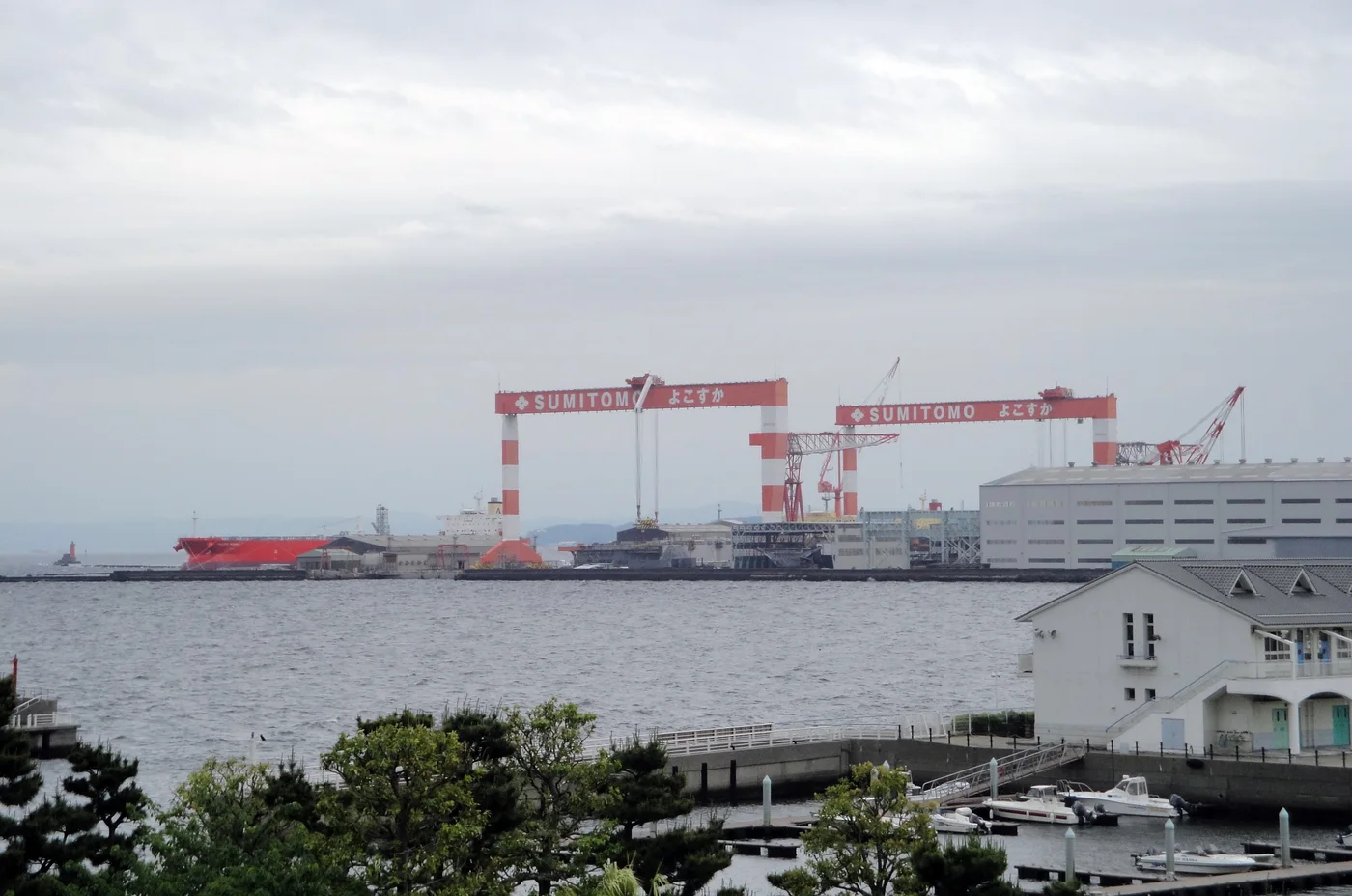
Sumitomo’s Yokosuka shipyard in May 2011. This later photograph shows the yard, not Seawise Giant under construction.
村上 敦 / Wikimedia Commons · CC BY-SA 2.1 Japan. Brightness previously adjusted on Commons by トトト. Resized and converted to WebP; responsive crop.
Seawise Giant was built at Sumitomo’s Oppama yard in Yokosuka, Japan. Sumitomo describes Oppama as a new yard established for larger merchant ships on Tokyo Bay, later known as Yokosuka Shipyard. Sumitomo’s history ↗ · Vessel sources ↗
Location matters: a large hull needs suitable building docks, waterfront access and a supply chain able to deliver machinery and major steel structures.
Why build a ship this large? →A starting point for the atlas, combining cruise yards and commercial shipbuilding centers.
Historic and shipyard pins indicate approximate areas, not exact berths or navigable routes. Current-vessel pins, when available, show timestamped AIS reports. A missing report does not establish a vessel’s location.
This Fincantieri yard on Italy’s Adriatic coast builds ocean cruise ships for Viking. Viking Vesta was delivered here in 2025.
Fincantieri ↗Place page →Fincantieri’s Marghera yard is on Venice’s mainland industrial waterfront. Norwegian Prima was delivered here in 2022.
Fincantieri ↗Place page →Fincantieri builds large cruise ships on the northern Adriatic here. Sun Princess was delivered from this yard in 2024.
Fincantieri ↗Place page →Meyer Werft builds cruise ships inland on the River Ems. Disney Wish left Papenburg along the river in 2022 before delivery.
Meyer Werft ↗Place page →Chantiers de l’Atlantique builds large cruise ships on France’s Atlantic coast. MSC World Europa was delivered here in 2022.
Chantiers de l’Atlantique ↗Place page →Fincantieri’s Genoa yard builds luxury cruise ships. Explora II was constructed at Sestri Ponente.
Fincantieri ↗Place page →A major shipbuilding region, including Hudong-Zhonghua’s LNG carrier construction.
China State Shipbuilding Corporation ↗Place page →Meyer Turku builds large cruise ships on Finland’s southwest coast. Icon of the Seas was delivered here in 2023.
Meyer Turku ↗Place page →Home to HD Hyundai Heavy Industries’ major shipbuilding complex.
HD Hyundai Heavy Industries ↗Place page →The historic Sumitomo yard where Seawise Giant was built.
Sumitomo Heavy Industries ↗Place page →Reviewed 6 October 2026. Industry figures describe 2025 output. Country of construction is different from flag state or owner nationality.
