Reported values from the references below. Cruise-ship beam uses the waterline measurement where supplied. Year may refer to delivery or first service.
Two triple-expansion steam engines and one low-pressure turbine
Why it was built
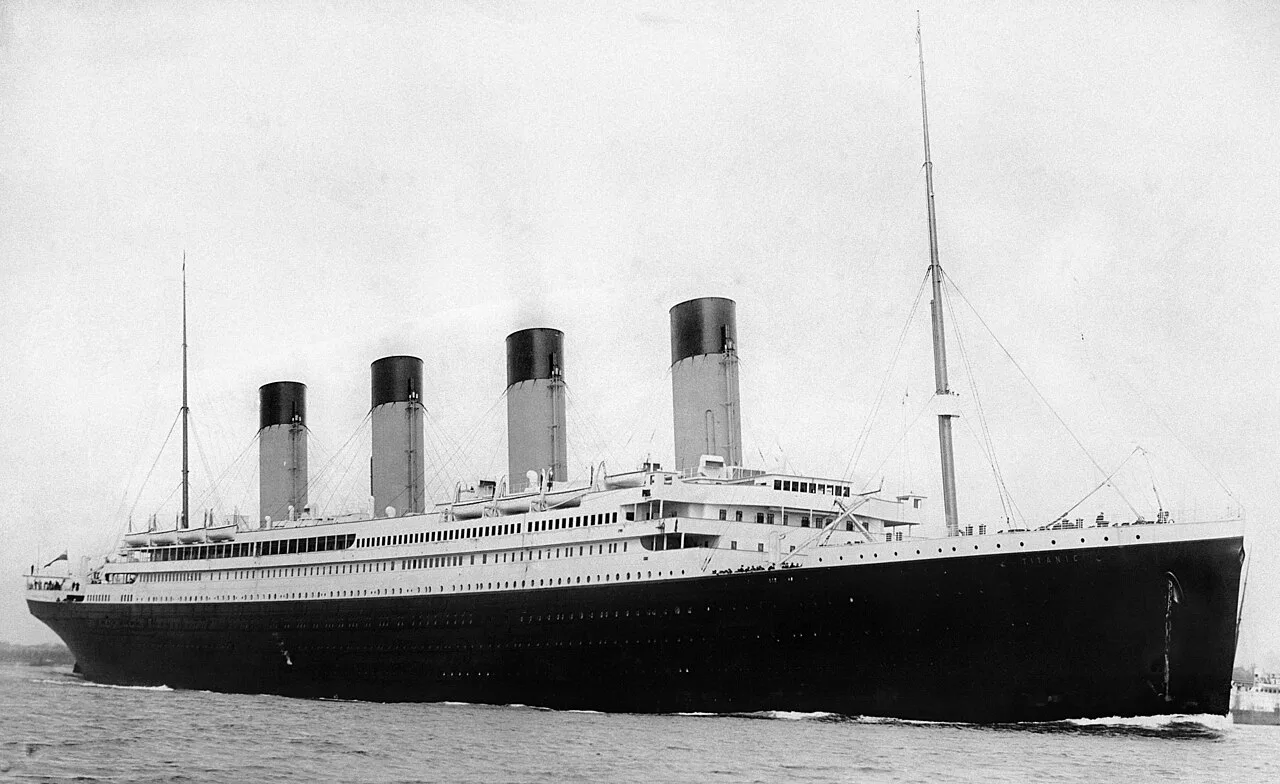
Titanic was built for White Star Line’s Southampton–New York passenger service. The British inquiry identifies that intended route. Its accommodation and scale belonged to a competitive Atlantic liner market, with passengers travelling for many different reasons rather than taking a modern resort cruise.
Harland & Wolff laid down the ship in March 1909, launched it in May 1911 and handed it over in April 1912. Titanic Belfast lists two triple-expansion reciprocating engines and a low-pressure turbine. The machinery combined different ways of extracting work from steam; it was not a diesel-powered ship.
Titanic sailed from Southampton in April 1912 and departed Queenstown, now Cobh, on 11 April bound for New York. The voyage ended in the North Atlantic disaster. Its historic gross register tonnage belongs to an older measurement system. Leaving the modern GT field empty is more accurate than creating an apparently comparable value by changing the unit label.
Length measures the vessel from end to end. Gross tonnage measures enclosed volume, not weight. Historical GRT is excluded from the GT ranking. Published figures can differ by configuration and measurement precision.
Vessel identity, dimensions, tonnage and historical status. Historical gross register tonnage is not treated as modern GT.
The main specification source is identified above. Additional references may report different configurations or precision. How this directory is compiled.
.jpg)
.jpg#Licensing)


