A shipbuilder’s tour of Europe: four countries behind the cruise fleet
From Finland’s southwest coast to the River Ems, the construction map tells a different story from a cruise itinerary.
By Alykhan Virani · 11 min read · Published
More in Shipbuilding →Running a giant series →Try the engineering lab →
Contents · 17 sections
Italy: several yards, several coastlines
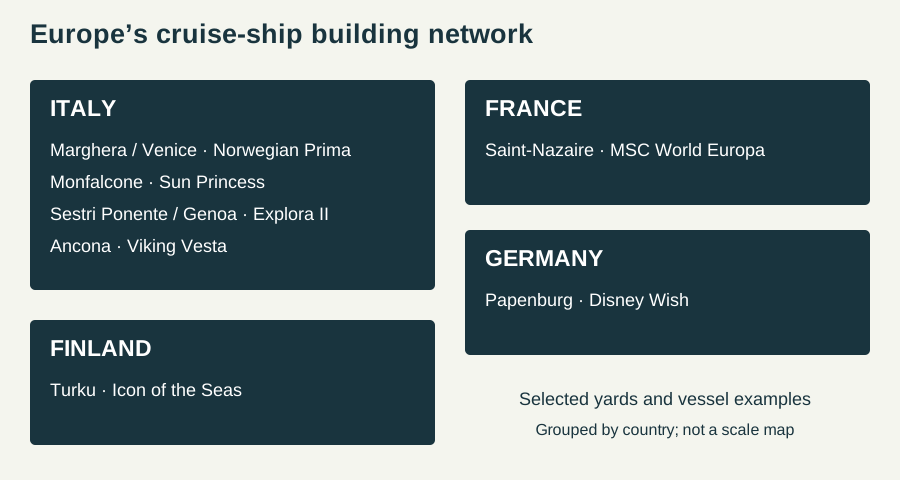
Italy’s cruise-ship industry spans more than one port. Fincantieri’s Marghera yard delivered Norwegian Prima, while Monfalcone delivered Sun Princess. Genoa’s Sestri Ponente and the Adriatic port of Ancona add further locations to the network. Looking at the yard, rather than only the builder’s corporate name, makes this geography visible.
France: Saint-Nazaire
Chantiers de l’Atlantique builds cruise ships at Saint-Nazaire on the Atlantic coast. MSC World Europa was delivered there in October 2022. A ship that passengers may associate with warm-water holidays can therefore begin its working life beside a very different stretch of coast.
Germany: an inland beginning
Papenburg is a useful reminder that a major cruise-ship yard does not have to sit on an open seafront. Meyer Werft builds ships inland on the River Ems. In 2022, Disney Wish left Papenburg along the river toward Eemshaven. That river journey is a distinctive part of the yard’s construction story.
Finland: Turku’s large cruise ships
Meyer Turku’s work includes Icon of the Seas, delivered in 2023. Turku places another major cruise-shipbuilding center on the Baltic side of the European map. Together, these locations offer a starting point for exploring the industry, rather than an exhaustive list or a ranking of national output.
Turn the map into a reading guide
Pick a ship in the directory, find its builder in the sources, and then locate the actual yard. Keep the construction location separate from the operator’s headquarters and the vessel’s flag. Those three places may all be different, and each tells you something different about the ship.
Compare yards by task, not just by ship length
A record-breaking hull is an easy headline, but it is only one way to describe a yard’s work. For a more useful comparison, distinguish the facilities used for assembly, the vessels delivered and the technical systems being integrated. A yard that builds a smaller luxury ship is solving a different product brief from one assembling a very large cruise vessel. Without a common measure and time period, a list of examples cannot establish which yard is most productive. The locations in this article are a geographical guide, not a league table of industrial performance.
Papenburg shows why the exit route matters
Disney Wish’s departure along the Ems illustrates a simple planning principle: building a vessel and moving it away from the yard are connected problems. The inland location is part of the project’s geography. It is tempting to infer exact size restrictions, tidal windows or tug requirements from a departure film, but those details need voyage-specific evidence. What the documented journey does establish is that an inland construction site can be connected to the sea by a carefully managed route. The ship’s first journey therefore belongs in the construction story as well as its service history.
Corporate names and physical locations are different labels
A builder’s name can cover several production locations. Fincantieri’s Italian cruise-ship yards demonstrate why a map should preserve the individual site names. Conversely, similar names can make readers conflate separate sites: Papenburg and Turku are different physical locations, and a vessel should be attributed to the yard documented for that project. For historical comparisons, retain the name used by the source at the time rather than silently applying a modern corporate label to every earlier delivery. This makes a shipbuilding timeline easier to audit.
A European delivery does not describe the whole supply chain
The final yard is a clear point on a map, while the origin of equipment and materials may be spread across many suppliers. It is therefore more precise to say where a named ship was built or delivered than to imply that every part originated in that country. As a general engineering observation, a complex vessel combines manufacturing and integration work. If the origin of a particular engine, pod or block matters to the story, document that component separately. A single national label is useful orientation, but it is not a complete industrial family tree.
A repeatable method for following a new vessel
Keep four entries as you follow a project: the operator, the named yard, the construction milestone and the date of the source. Add dimensions only when the announcement actually supplies them, and distinguish gross tonnage from weight. When a second announcement appears, update the timeline rather than replacing its earlier steps. This method works across all four countries in this tour. It also prevents a delivery announcement, a maiden voyage and a naming ceremony from being flattened into one ambiguous “launch” date.
Italy’s network: follow the individual production sites
Fincantieri’s first-half 2025 review provides a useful cross-section of the Italian network. It identifies Norwegian Aqua with Marghera, Mein Schiff Relax with Monfalcone and Viking Vesta with Ancona. The same review records the July delivery of Oceania Allura from Sestri Ponente. These examples link individual projects to physical places instead of treating a corporate headquarters as the location of every ship’s construction.
The geography is also varied. Marghera and Monfalcone lie around the northern Adriatic, Ancona further down the Adriatic coast, and Sestri Ponente is part of Genoa on the Ligurian side. The schematic map groups the yards by country while retaining the location names. It does not depict transport links or suggest that all component movements follow the straight lines used to organise the illustration.
A network can share experience without making its sites interchangeable. A specific ship is still built under a particular project arrangement, at documented locations and with a defined delivery sequence. When comparing the yards, use the actual vessels and dates rather than assuming that all Fincantieri cruise ships come from the same facility. This site-by-site approach also helps explain why the Italian story contains several simultaneous construction programmes rather than a single national production line.
Sources: [8] Fincantieri: first-half 2025 delivery review ↗
Saint-Nazaire: why the preparation area matters as much as the crane
Chantiers de l’Atlantique’s 2018 announcement about a pre-assembly expansion gives a concrete example of industrial capacity. The yard described extending the rail for its 1,400-tonne gantry crane and increasing simultaneous block preparation capacity from sixteen to twenty-two blocks. Those figures describe that announced investment at that time. They should not be silently presented as a complete inventory of the yard’s current facilities.
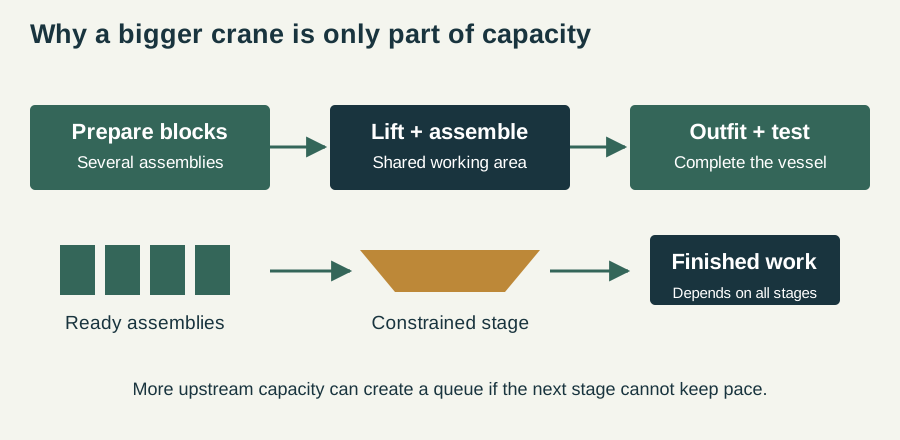
The useful engineering lesson is the relationship between lifting and preparation. A large crane can move an assembly only when the assembly is ready, accessible and within the planned lift conditions. Space in which blocks can be assembled and outfitted therefore supports the crane’s work. Capacity is a system property: an impressive lifting rating is one part of the process, not a direct measure of annual completed ships.
The diagram of parallel work shows why this matters. Several assemblies can be prepared while another is being positioned in the building area. Keeping those activities coordinated reduces the need for the most constrained area to perform every earlier task. The general principle is comparable to preparing components beside an assembly line. The shipyard application is physically much larger, and the actual scheduling remains specific to the project and its equipment.
Sources: [6] Chantiers de l’Atlantique: pre-assembly expansion, 2018 ↗
Papenburg: covered construction and the river journey
Meyer Werft describes two covered building docks and a production system using digital planning and short internal logistics routes. Covered construction is a feature of the production environment, while the River Ems is a feature of the route away from the yard. The two should be considered together when explaining Papenburg: the ship is assembled in one setting and must subsequently make a controlled transition to another.
A covered dock does not remove every environmental or logistical constraint. Equipment still has to reach its work area, the vessel still needs to leave the building, and its onward movement still occurs outside. What the enclosure provides should therefore be described in relation to the work performed inside it rather than as a claim that weather has no influence anywhere in the project.
Disney Wish’s documented Ems departure in 2022 supplies a memorable example of the geography. The journey demonstrates a connection from an inland yard toward the sea, but its exact operating arrangements cannot be inferred for every later ship. For each vessel, draught, clearances and the movement plan are project-specific matters. A photograph of a successful transit is evidence of that transit, not a general permission for any ship of a similar length to use the same route.
Sources: [9] Meyer Werft: digital design and production facilities ↗ [4] Meyer Werft: Disney Wish leaves Papenburg ↗
Turku: interpret a giant through its delivery record
Meyer Turku announced the delivery of Icon of the Seas in November 2023. That dated record provides a stronger starting point for the construction history than a later photograph in passenger service. It ties a named ship to a builder, location and milestone. From there, a reader can connect the vessel’s industrial history to the particulars documented by the yard and operator.
Very large cruise ships also show the limits of a single size measurement. Length describes the hull’s extent in one direction, while gross tonnage describes enclosed volume. Passenger capacity introduces another dimension. A ship may be exceptional in one measure without holding the same position in another, which is why our directory keeps the rankings separate. The construction challenge involves the arrangement inside that volume as well as the outer dimensions.
For a yard, the interior is a systems-integration problem. Power, accommodation, ventilation and service spaces must coexist within the design. This observation does not reveal Turku’s internal project schedule or establish a productivity comparison with another yard. It explains why a large delivery represents more than a single oversized steel object. The vessel’s visible scale is the result of many connected design and assembly decisions reaching the same completed milestone.
Compare outputs without confusing volume, weight and effort
A fair comparison begins with a defined question. If the question is which vessel is longest, use length on a consistent basis. If it is how much enclosed volume was delivered in a year, gross tonnage may be a useful measure. If it is how much fabrication or outfitting effort was required, neither measure is sufficient alone. The amount and complexity of work inside the hull matter as well as its size.
Consider a fictional example: Yard A delivers two ships of 100,000 GT each, while Yard B delivers one ship of 180,000 GT. A gross-tonnage sum gives Yard A the larger total, 200,000 GT. That arithmetic does not establish that Yard A used fewer work hours, earned more money or solved a more difficult design problem. Those questions require their own evidence. The example is deliberately invented to show the difference between calculating a metric and interpreting it.
The same caution applies to capacity announcements. Extra floor area, a higher crane rating, a new dock and more completed ships are four different observations. One may contribute to another, but the relationship is not automatic or immediate. Keeping the quantities labelled allows the reader to appreciate the scale of a project without turning an interesting industrial fact into an unsupported league table.
The regulatory framework is part of the product
A cruise ship is not simply a building that happens to float. Its design must address the consequences of operating at sea with large numbers of people onboard. IMO’s passenger-ship guidance discusses the international safety framework, including subdivision and damage stability. The specific rules applicable to a vessel depend on its circumstances; the point here is that safety requirements are part of the engineering brief from the outset.
This has direct consequences for the internal arrangement. Space is needed for more than passenger attractions and cabins. Machinery, services, circulation and protective arrangements all need to be incorporated into the design. A change that seems to add only a small amount of revenue-generating space may interact with those other requirements. The design task is to make the complete arrangement work together.
European yards deliver different products within this wider framework. It would be misleading to imply that being built in a particular country, by itself, demonstrates a particular level of comfort, reliability or safety. The relevant evidence concerns the vessel’s design, construction, applicable standards and operating arrangements. The yard’s experience matters, but a geographical label cannot substitute for the project-specific record. This is another reason the map is an introduction to the industry rather than a quality rating.
Why the next generation is an integration challenge
New propulsion and energy systems affect more than the machinery list. An energy store needs space, supporting equipment, controls and a defined operating role. Its installation can change the relationship between the electrical plant and the rest of the vessel. The shipbuilder must incorporate that arrangement while retaining the other functions expected of the ship. This is a general design principle rather than a prediction that every yard will adopt the same technology.
A useful way to visualise the task is to draw three connected layers: energy supply, ship services and the passenger product. A change in one layer can alter demands on the others. For example, a different energy-storage arrangement may change the space available for another purpose; a new hotel feature may add electrical demand. Thinking in these three layers makes the relationships explicit without prescribing an actual machinery design.
Future announcements should therefore be read at the level of demonstrated commitments. A concept is a design proposition, an order is a commercial commitment, and a delivered installation is a different stage of evidence. The European construction map will continue to change as individual projects advance. Following those stages at named yards provides a more durable understanding than declaring one technology or country the inevitable winner on the strength of a promotional rendering.
Sources & further reading
An editorial explainer based on the technical, research and industry references below.
- Fincantieri: Italian cruise-ship production sites ↗
- Fincantieri: Sun Princess delivery ↗
- Chantiers de l’Atlantique: MSC World Europa delivery ↗
- Meyer Werft: Disney Wish leaves Papenburg ↗
- Meyer Turku: Icon of the Seas ↗
- Chantiers de l’Atlantique: pre-assembly expansion, 2018 ↗
- Meyer Turku: Icon of the Seas delivery, 2023 ↗
- Fincantieri: first-half 2025 delivery review ↗
- Meyer Werft: digital design and production facilities ↗
- Chantiers de l’Atlantique: MSC World Europa particulars ↗
- IMO: passenger-ship safety framework ↗