Running a giant ship: people, fuel, provisions, maintenance and money
What it takes to keep a large vessel working, from watchkeeping and refrigerated stores to fuel budgets, port calls, dry docking and the costs a headline price leaves out.
By Largest Ship in the World · 12 min read · Published
More in RUNNING A GIANT →Running a giant series →Try the engineering lab →
Contents · 16 sections
Size is only the visible part
The dimensions of a giant ship are easy to compare. The organization needed to run it is harder to see. Every voyage depends on people, machinery, supplies, maintenance and shore support arriving in the right combination. A ship can be mechanically capable of sailing while waiting for cargo, a berth, a spare part or a suitable operational condition. Its commercial performance depends on all of those connections.
A container ship, tanker and cruise ship solve different problems. Their crew structures, cargo systems and service demands should not be compressed into one supposedly typical daily cost. This guide follows the functions they share and explains where their differences matter. Numerical examples are explicitly hypothetical. They show how to build a calculation without presenting assumed fuel prices, staffing levels or consumption rates as private facts about a named vessel or as current market quotations.

A ship is a network of departments
The deck function covers navigation and much of the work associated with the hull, mooring and cargo operations. Engineering supports machinery and electrical services. Catering and other hotel functions sustain the people aboard, with a much larger passenger-service organization on a cruise ship. These functions overlap whenever a task depends on more than one system, such as a port movement requiring propulsion, steering, mooring equipment and communication.
The practical challenge is coordinating work without losing sight of the whole ship. A maintenance task may remove equipment another department expects to use. Loading cargo can change ballast requirements. A schedule alteration can affect food stores, fuel planning and rest. The ISM framework helps explain why procedures and clear responsibilities belong alongside the physical equipment. The ship is not a collection of independent departments that happen to share an address; their actions continuously change each other’s operating conditions.
Sources: [3] IMO: International Safety Management Code ↗
Watches keep a vessel working around the clock
Ocean passages do not stop overnight. Navigation, machinery monitoring and other functions must be maintained through an arrangement suited to the ship and its operating condition. Watchkeeping transfers responsibility between people, so handovers need to preserve information about equipment, weather, traffic and work in progress. A quiet control room is not evidence that nothing needs attention.
The availability of people must also account for rest, maintenance, drills and port work. A busy arrival after a passage can create a different workload from steady sailing. IMO and ILO material on work and rest provides context for why fatigue is an operational concern rather than a personal inconvenience. There is no single watch schedule appropriate to every vessel. The useful question is whether the staffing and working arrangement can support the complete task, including the predictable peaks of activity.
Crew numbers need a definition
A headline crew number can conceal differences in what is being counted. A cargo ship’s complement serves a different purpose from the combined marine and passenger-service personnel on a large cruise ship. A temporary yard team or contractor group is another category again. Comparing those totals without identifying the vessel’s work creates an impression of efficiency or excess that the figures cannot support.
The Maritime Labour Convention addresses living and working conditions, including accommodation, food and health-related provisions. Those needs do not disappear because a ship is highly automated. Automation changes tasks and information flows; it does not eliminate maintenance, emergency response or the human judgement involved in unusual situations. A useful ship profile therefore separates passenger capacity, marine staffing and wider service roles where the source provides that distinction. Where it does not, the responsible answer is to leave the comparison incomplete.
Provisioning starts before the gangway comes down
Food planning connects the number of people aboard with voyage duration, menus, storage and the opportunities to replenish. Dry goods, chilled food and frozen stores have different requirements. Receiving supplies also involves inspection, documentation and moving them through the vessel without obstructing other operations. On a large passenger ship, this is part of a substantial hotel operation; on a cargo ship, it remains essential to a small community living far from ordinary shops.
For an original arithmetic example, imagine 100 people consuming an assumed two kilograms of food ingredients each per day over ten days. That yields two tonnes before any additional allowance, packaging or beverage requirement. The assumption is not a catering standard. Its purpose is to show how quickly a per-person quantity becomes a logistics task, and why changing voyage duration matters. A real provisioning plan uses actual menus, consumption experience, storage limits and arrangements appropriate to the people aboard.
Cold stores and freshwater are machinery questions
Supplies depend on services. A cold room requires electricity and a way to reject heat. A galley needs ventilation, water and fire protection. Freshwater production or shore supply needs storage, distribution and quality management. Equipment that looks like a minor auxiliary in a propulsion diagram can therefore determine whether the ship can sustain normal life aboard.
The energy consumed by these services continues while a ship is alongside. A passenger vessel can have significant demand even with its propellers stopped. That makes the boundary of an energy comparison important: main-engine fuel alone may not describe the full day. The engine-room guide traces these support systems in more detail. Here the operational lesson is that provisioning and machinery cannot be planned in isolation. A full store room is of limited value if the equipment protecting its contents is unavailable.
Fuel planning is about energy and resilience
Fuel carried is not simply the expected consumption multiplied by the shortest advertised travel time. The planning context includes the voyage, machinery characteristics, possible delays and the arrangements for replenishment. Different fuel types also have different storage and handling implications. The volume of a tank and the energy that its contents can deliver are related but distinct quantities.
An operator needs measurements and assumptions that match the ship’s actual use. A long passage at steady load differs from repeated short legs and port operations. Weather and hull condition affect the demand for propulsion. Generators and boilers may add consumption outside the main propulsion figure. A credible public explanation should identify those boundaries before comparing ships. It should also distinguish a design estimate, a trial result, a reported annual total and an individual voyage record, since each describes a different kind of evidence.
A transparent example of fuel cost
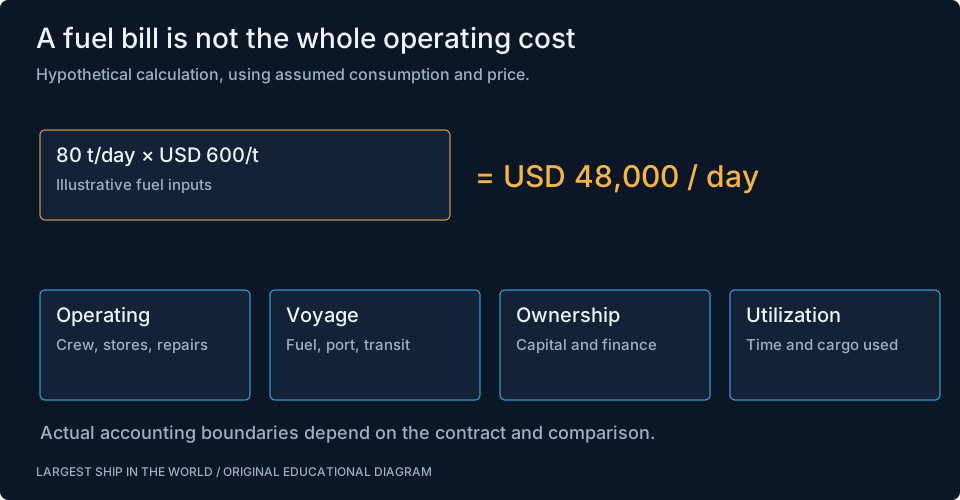
Assume, purely for illustration, a total consumption of 80 tonnes per day and a fuel price of 600 US dollars per tonne. The daily fuel bill is 48,000 dollars. Over ten days at that unchanged rate, it would be 480,000 dollars. Neither input is a current quotation or a verified value for a vessel in this directory. The arithmetic is useful because it makes the assumptions visible and replaceable.
Now change only the price to 750 dollars per tonne. Consumption has not changed, but the daily bill becomes 60,000 dollars. Alternatively, reducing consumption to 70 tonnes at the original assumed price produces 42,000 dollars per day. These comparisons show why a headline operating-cost claim needs both a date and a boundary. They do not include crew, insurance, repairs, port charges, financing or time lost. Fuel is one category in the economics of a voyage, not a complete profit statement.
Speed changes both cost and schedule
A faster passage may increase propulsion demand while reducing time at sea. A slower passage can save fuel under suitable conditions but uses more time and may affect the service schedule. The tradeoff involves the whole operation: cargo commitments, passenger itineraries, berth availability and the number of ships needed to maintain a service. It cannot be settled by saying slow is always cheaper or fast is always more productive.
Simple power-versus-speed rules can be helpful within a limited range, but should not be extended blindly across loading conditions, hull forms and sea states. The engine also has its own efficiency characteristics. A careful comparison would use an appropriate performance model and state its assumptions. For the reader, the main insight is that the time dimension matters. A ship consumes resources while waiting as well as while moving, and the best point for one voyage may differ from another.
A port call is a synchronized operation
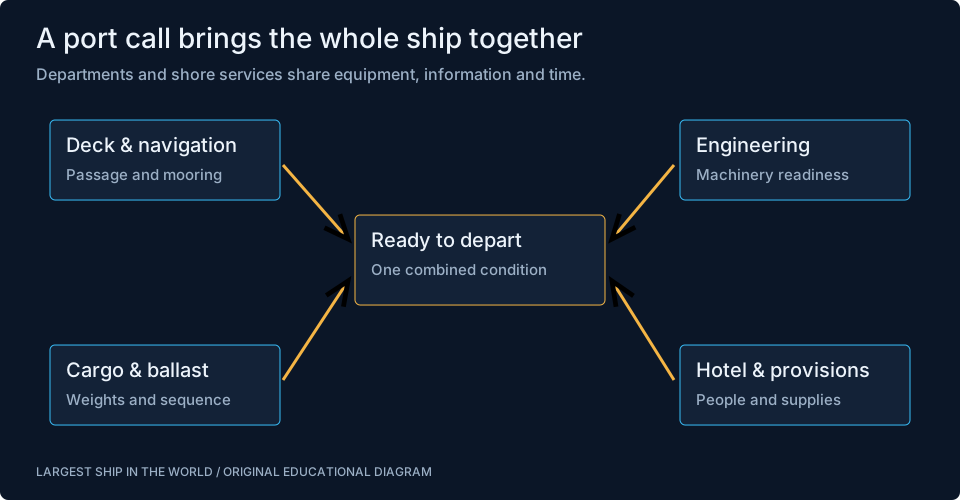
Approaching the berth may involve a pilot, tugs, line handlers and a berth allocation. Once alongside, cargo work or passenger turnaround overlaps with supplies, waste reception, crew movements and maintenance opportunities. Each activity has constraints of space, equipment and timing. A late change in one workstream can affect several others, even if the ship’s own machinery is working normally.
The final condition must also be ready for departure. Cargo and ballast need to agree, equipment required for manoeuvring must be available and unfinished work must be understood. A port call therefore resembles a coordinated project more than a pause in the voyage. Its success is not measured only by how rapidly a crane moves boxes. The entire sequence, from arrival readiness to a properly prepared departure, determines how the ship returns to service and what unresolved issues travel with it.
Maintenance competes for the same time and access
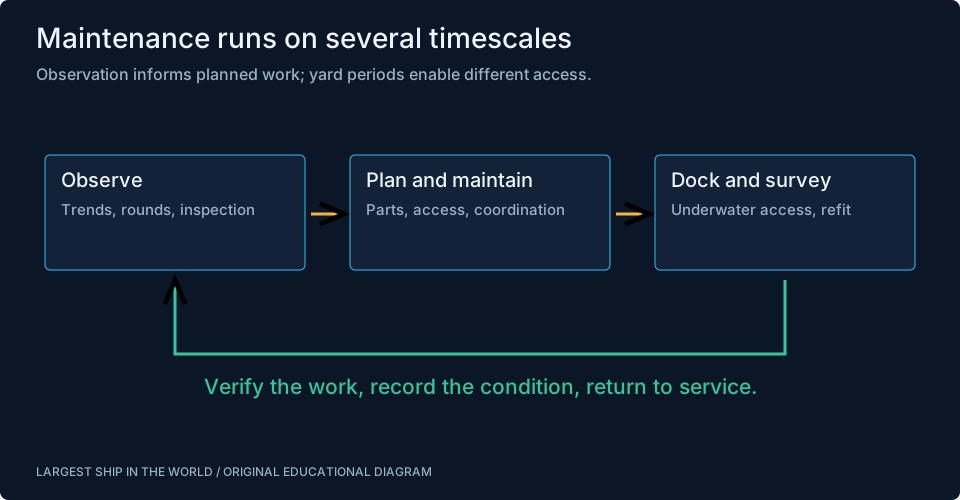
Routine observation can identify work that should be planned before equipment fails. Engineers and deck crews then need parts, tools, access and a suitable operating window. Some jobs can proceed while the ship sails; others depend on machinery being unavailable or the vessel being in a yard. Scheduling is therefore part of the technical solution, not an administrative detail added after the repair has been designed.
A useful distinction is between the cost of a component and the cost of its failure. A relatively inexpensive part can cause substantial disruption if it disables a service or cannot be obtained at the next port. Conversely, replacing something unnecessarily can introduce errors or use a scarce maintenance opportunity. Condition information, maker guidance and operational experience support the decision. The objective is dependable service over time, with a clear account of what has been inspected, changed and returned to use.
Dry docking is a concentrated project
A dry dock exposes underwater parts of the hull and provides access that is unavailable during normal afloat operation. Propellers, rudders, sea connections and coatings can be inspected or worked on, while other tasks may proceed inside the ship. The programme must coordinate yard facilities, materials, subcontractors, surveys and the vessel’s eventual return to service.
Queen Mary 2’s documented refit illustrates that a passenger ship can undergo significant changes without becoming a new hull. The gallery’s Hamburg dry-dock photograph shows cranes and staging around the existing vessel. Such images also reveal why refit work differs from building on a clear site: access is constrained by equipment and spaces already aboard. The task includes protecting what remains, connecting new work to old systems and verifying the combined result. A completion date needs to account for testing and commissioning, not only the last visible installation.
Sources: [6] Cunard: Queen Mary 2 history and refit ↗
Waste has to leave through another logistics chain
Food, packaging, machinery operation and daily life produce different waste streams. They need appropriate collection and handling arrangements. Sludge from fuel treatment is not the same as ballast water, and sewage is not the same as ordinary garbage. Treating everything as waste water obscures the equipment and requirements that apply to each stream.
The ship’s systems and shore reception arrangements must work together. Storage capacity matters when the next suitable service is not immediately available. A cleaner or more efficient component may reduce one burden while leaving other streams unchanged. Environmental performance is therefore better described through specific functions than through a single broad adjective. The linked IMO material provides the regulatory context; the engineering task is to keep each flow identifiable, manage it through the appropriate equipment and preserve records of what was done.
Sources: [5] IMO: ballast water management ↗ [7] IMO: pollution prevention ↗
Ownership, voyage and operating costs differ
A build price describes acquisition, not the cost of running a ship each day. Financing and depreciation belong to a different part of the accounting from fuel, repairs or a port call. Charter arrangements can also allocate particular costs between parties. A public figure called daily cost may therefore include a different set of items from another figure carrying exactly the same label.
For a useful comparison, start with a boundary. Are we comparing cash spent on one voyage, annual technical operation or the complete ownership economics? Then identify capacity used and the output delivered. A partly loaded ship and a fully utilized ship can spread costs over different quantities of cargo. Passenger occupancy creates another kind of denominator. None of these observations requires guessing a company’s private accounts. They explain which information would be needed before a simple ranking could support a meaningful conclusion.
A day at sea is also a day of information
Weather forecasts, machinery trends, position reports, stores and maintenance records all contribute to the next decision. The challenge is knowing which information is current, what it measures and where it is uncertain. AIS illustrates this distinction well: a received position can locate a report, but does not reveal the complete operational plan or establish every detail of the ship’s condition.
Our tracking page therefore separates last-received observations from documented historical route stories. The same discipline applies to operational writing. A published itinerary is a plan; a dated port report is evidence of a call; a general service description is a commercial pattern. Keeping those categories visible helps readers understand shipping without implying access to information the site does not possess. Running a giant ship depends on reliable information, and explaining one should follow the same principle.
Bring the systems back together
Take a single departure and trace its dependencies. The ship needs an appropriate loading condition, propulsion and steering readiness, people able to perform their roles, provisions for the voyage and a plan consistent with the port and weather. Its costs reflect both the resources consumed and the time taken. Every department contributes, while shore services make several of those contributions possible.
That is why this series connects ship handling, ballast and engine-room life. The subjects are easier to learn separately, but the vessel operates them together. Use the cutaways to locate the equipment, the engineering lab to explore simplified forces and the galleries to see the physical scale. Then return to the ship histories to understand how a vessel’s job can change over time. The achievement of a giant ship is not merely carrying an impressive amount, but repeatedly making the whole operation work.
Watch the engineering in action
Sources & further reading
An editorial explainer based on the technical, research and industry references below.