Venice builds cruise ships, too: a closer look at Marghera
Beyond Venice’s familiar waterfront lies an industrial story, with cruise ships built at Marghera.
By Alykhan Virani · 11 min read · Published
More in Shipbuilding →Running a giant series →Try the engineering lab →
Contents · 16 sections
Put the pin on Marghera
For cruise-ship construction in the Venice area, the place to look is Marghera. Fincantieri identifies the location as Marghera (Venice) in its delivery announcements. The yard belongs to the mainland industrial waterfront, giving the Venice name a very different setting from the canals and squares most visitors picture.
Follow a class through the yard
Norwegian Prima was delivered at Marghera in July 2022. Fincantieri described it as the first vessel in Norwegian Cruise Line’s Prima Class. In 2026, the same yard delivered Norwegian Luna, a ship in the expanded Prima Plus Class. Those examples show why a yard’s history is often best understood through a sequence of related vessels rather than one famous hull.
One city name, several maritime roles
A ship’s construction location answers where it was built. Its home port describes a different relationship, and the ports on a passenger itinerary describe another. Keeping those labels separate is particularly useful when reading about Venice: a reference to a ship being built at Marghera does not by itself tell you where its cruises will begin.
Look along the rest of Italy’s coast
Marghera is one part of a wider Italian cruise-shipbuilding network. Fincantieri has also built cruise ships at Monfalcone, Sestri Ponente in Genoa and Ancona. Our shipbuilding atlas places those yards on a map with individual vessel examples, making it easier to trace the geography behind the names on the hulls.
Build a timeline from primary announcements
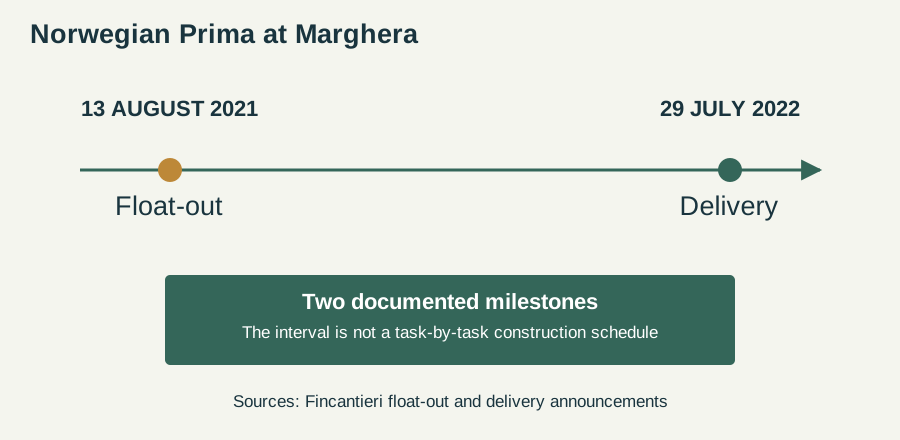
Norwegian Prima provides a useful case study because the builder published separate float-out and delivery announcements. The float-out took place in August 2021; delivery followed in July 2022. That gap is more informative than a single launch date. It shows that entering the water and handing a vessel to its owner are separate events. Avoid using the interval as a standard fitting-out duration for other ships, however. It describes this particular project. A rigorous timeline records the named milestone, its source and its date before trying to compare one vessel with another.
Why sister ships deserve individual records
A class name helps connect related ships, but it should not erase differences between them. The Prima and expanded Prima Plus descriptions in Fincantieri’s announcements are an example of why the exact class wording matters. For a useful comparison, create a separate line for each ship’s delivery date, dimensions, gross tonnage and machinery references. Do not assume a photograph, engine specification or passenger capacity automatically transfers from one sister ship to the next. This is particularly important in a growing series, where later vessels may be enlarged or changed even though the names remain closely associated.
A yard is more than its building dock
A cruise ship combines its hull with electrical distribution, propulsion, accommodation and the systems needed to support people at sea. As an engineering interpretation, that makes the yard a place where many specialisms must be coordinated. The dock supplies a physical setting for assembly; it does not describe the whole project. For anyone studying Marghera, a better question than simply “how big is the dock?” is “what sequence of work produces the completed vessel?” Builder announcements supply dated checkpoints, while technical supplier references can fill in the machinery story.
What a map can and cannot establish
A pin for Marghera helps explain where final construction activity is located. It does not identify the origin of every component or prove where all the steel was fabricated. Nor does a ship’s presence beside the yard necessarily mean it is a newbuild: the reason for a particular visit needs its own evidence. Treat location, activity and date as separate facts. A dated photograph can support the first of those very well while leaving the others uncertain. This approach also makes historic images easier to caption without implying that they show today’s production schedule.
Plan your next step through the evidence
Start with our shipbuilding atlas to locate Marghera, then open the linked builder announcement for a named vessel. Read its milestone wording before moving to the vessel’s profile. If you want to understand how that vessel moves, follow the machinery source rather than inferring its propulsion from the cruise line or construction city. Keeping the geographical story connected to individual records makes the Venice chapter more useful than a list of impressive ships. It also leaves room for the history to grow as further deliveries are documented.
Norwegian Prima: what the published dimensions actually describe
Fincantieri’s vessel page gives Norwegian Prima a gross tonnage of 142,500, a length approaching 300 metres and accommodation for 3,215 guests. These are useful descriptive figures, but they should not be collapsed into one idea of size. Length describes a linear dimension. Gross tonnage is a measure derived from enclosed volume, not the ship’s weight. Guest capacity describes people under a particular published accommodation basis. None of those numbers, by itself, tells us the mass of steel, the installed propulsion power or the work hours used at Marghera.
This distinction matters when comparing Prima with a later vessel. An increase in gross tonnage does not necessarily imply the same percentage increase in length or guest numbers. More enclosed space may be distributed across different kinds of accommodation and public areas. A comparison needs matching definitions before percentages become informative.
An illustrative calculation makes the issue clear. If two imaginary ships carry the same number of guests but one has more enclosed volume, their space-related measures differ even though their passenger counts match. That does not establish service quality, operating cost or construction difficulty. For the Marghera story, the published particulars are a starting point for understanding the product the yard delivered. They are not a substitute for a detailed engineering specification.
Sources: [5] Fincantieri: Norwegian Prima vessel particulars ↗
The long interval between first water and handover
The August 2021 float-out and July 2022 delivery of Norwegian Prima create two firm checkpoints. Between them lies work that the familiar hull photograph cannot fully reveal. Accommodation, technical services, equipment integration and testing all contribute to turning an assembled vessel into a ship ready for handover. This is a general description of the work involved, not a claim that every listed activity began only after Prima entered the water.
The distinction is important because modern construction moves some outfitting earlier, while structural assemblies remain accessible. Float-out changes the vessel’s physical setting; it does not reset every workstream to its beginning. Nor should the period between those two dates be described as time spent solely installing interiors. The public milestones establish a sequence, not a detailed breakdown of every task.
The timeline diagram deliberately uses milestone labels rather than an invented percentage-complete curve. A ship might look almost finished from one viewpoint while technical testing continues elsewhere. If a builder later announces trials, delivery or a further construction stage, those observations can be added to the record. They should not be interpolated from photographs alone. This is how a construction history remains useful without pretending that a public news archive contains the yard’s internal schedule.
Sources: [4] Fincantieri: Norwegian Prima float-out, August 2021 ↗
What capacity investment at Marghera means in practice
Fincantieri’s 2023 annual report describes completion of a major project involving operating areas and infrastructure at Marghera, intended to improve production capacity and efficiency. The report supports the existence and stated purpose of the investment. It does not mean that every visitor can translate a new building or paved area directly into an extra annual ship delivery.
A yard’s output depends on a chain of activities. Imagine, as an example, that block fabrication can produce assemblies faster than the available outfitting teams can complete them. Increasing fabrication alone could produce a larger queue rather than a proportionate increase in finished vessels. If a transport route limits movement to the dock, extra storage space may help in a different way from another fabrication line. These are general production principles, not a diagnosis of Marghera’s actual bottlenecks.
The practical value of an infrastructure programme is therefore best assessed against the stage of work it supports. Does it reduce handling, permit more parallel preparation, improve access or release occupied space sooner? The public report identifies the strategic purpose; a detailed operational assessment would need further data. Keeping those two levels separate makes the investment story more intelligible than presenting every expansion as simply a larger dock.
Sources: [6] Fincantieri: Marghera capacity works in the 2023 annual report ↗
A floating hotel creates a very different coordination problem
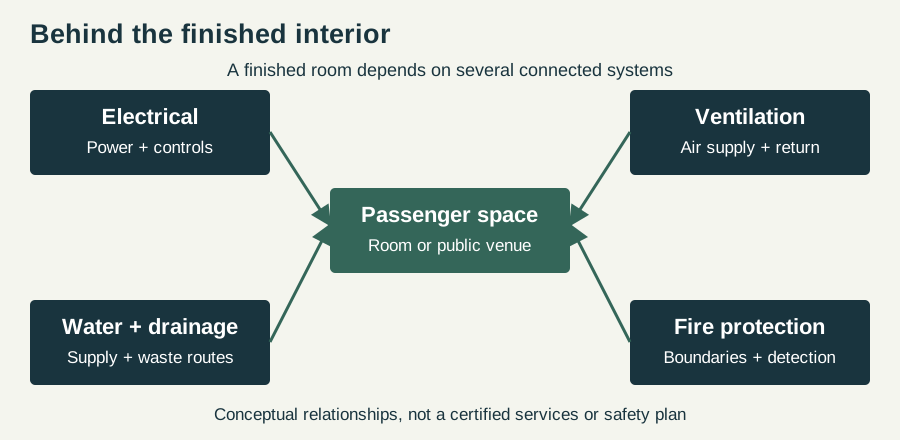
The visible passenger spaces are only the final surface of the product. Behind an attractive interior sit supporting structure, electricity, ventilation, fresh-water services, drainage, alarms and many individual equipment connections. An interior designer’s decision about a room can therefore create requirements for several technical disciplines. The yard must turn those requirements into work packages that can be installed in the right sequence.
Consider a hypothetical dining venue that is enlarged late in design. Its extra seats are the obvious change. The less obvious questions concern galley service, storage, circulation, electrical demand, ventilation and the routes people use to leave the space. This example is not an account of a change on a Marghera-built ship. It illustrates why cruise construction involves a large amount of coordination that cannot be expressed by hull dimensions alone.
Fire protection makes these interfaces particularly important. IMO describes a framework covering prevention, detection and extinction aboard ships. A decorative finish is part of an arrangement with technical requirements; a duct or cable crossing a boundary has to be considered in that context. The connection diagram shows how a public room depends on several systems simultaneously. It is conceptual, and intentionally avoids representing an actual vessel’s safety plan or equipment routing.
Sources: [9] IMO: fire protection ↗
Follow the yard across different operators
Marghera’s output is not represented by a single cruise line. Fincantieri announced the launch of Carnival Horizon at the yard in March 2017. Norwegian Prima supplies a later example, while Oceania’s August 2026 announcement places Sonata at the same yard for float-out. These are specific, dated observations across different projects. They demonstrate variety in the yard’s cruise work without requiring us to invent a complete orderbook.
Different operators do not imply that every production method changes from scratch. The general processes of fabrication, assembly, outfitting and testing remain recognisable. The product brief, however, changes the arrangement of the spaces and systems being built. For a reader, the useful comparison is between the project requirements and the completed ship, rather than an assumption that one operator’s visual style determines the entire engineering approach.
Oceania’s Sonata announcement is particularly helpful because it explicitly describes the next stage: moving to a fitting-out berth for further interior work, with a future passenger debut planned. A float-out announcement can therefore communicate both an achievement and substantial work still to come. That is a richer description than calling the ship finished because its hull is afloat.
Sources: [7] Fincantieri: Carnival Horizon launched at Marghera ↗ [8] Oceania Cruises: Sonata float-out and fitting-out ↗
The geography of an industrial waterfront
Marghera connects the Venice name to the production and movement of very large objects. At the scale of a shipyard, geography becomes operational: an assembly needs a route to the place where it will be lifted, suppliers need access, and the completed hull needs a way to leave its construction setting. Our shipbuilding atlas locates Marghera on the mainland side of the Venice area. Its markers orient the reader; they are not a navigational chart or a guide for moving a vessel.
This also explains why a map pin cannot describe the whole supply chain. A component can be manufactured elsewhere, transported to the yard, installed into a larger assembly and finally delivered as part of the ship. Each of those activities has a location. The final yard is an important integrating location, but it is not evidence that every upstream step happened beside the dock.
For an individual project, the appropriate level of detail depends on the evidence. A builder’s delivery announcement can establish the yard. A supplier’s equipment announcement can establish an installation. A transport record may establish a large component movement. Combining such records produces an industrial history; assuming their contents from the ship’s flag or owner nationality does not.
From delivery to the first paying passenger
Delivery is a contractual and operational milestone between the builder and the owner. A naming ceremony, positioning voyage and first passenger sailing can occur on different dates and in different places. This creates an understandable source of confusion: publicity may focus on a highly visible celebration, while the construction record centres on handover. Both can be correct accounts of different events.
For a Marghera-built vessel, a later ceremony in another city does not move the construction site to that city. Likewise, an itinerary beginning abroad does not tell us where its machinery was installed. Our timeline maintains separate categories so that a ship’s industrial origin and passenger career remain connected without becoming interchangeable.
The most useful conclusion is a practical one. Venice’s cruise-shipbuilding story is about a place that integrates structure, machinery and accommodation into a working vessel. Norwegian Prima, Carnival Horizon and Oceania Sonata provide documented glimpses of that activity at different times. The diagrams explain the relationships behind those announcements, while the sources retain the exact boundaries of what is known about each ship. Future updates should add new project evidence to this record rather than replace it with a list of whichever ships happen to be most prominent today.
Sources & further reading
An editorial explainer based on the technical, research and industry references below.
- Fincantieri: Norwegian Prima delivered in Marghera ↗
- Fincantieri: Norwegian Luna delivered in Marghera ↗
- Fincantieri: cruise-ship production sites ↗
- Fincantieri: Norwegian Prima float-out, August 2021 ↗
- Fincantieri: Norwegian Prima vessel particulars ↗
- Fincantieri: Marghera capacity works in the 2023 annual report ↗
- Fincantieri: Carnival Horizon launched at Marghera ↗
- Oceania Cruises: Sonata float-out and fitting-out ↗
- IMO: fire protection ↗